Friday, December 16, 2022

Short Film Research: The Life and Death of Tommy Chaos and Stacey Danger

CAMS

  • The close up allows the audience to see the closeness between the two characters.
  • The pan allows for the audience to see the movement that the two characters are doing together.
  • Two shots show just how close the characters are and how important each is to the other.
  • The wide shot shows how small of a space that the movie is in.
Mis-en-scene
  • The setting used looks complex and advanced allowing for the audience to see the time period it is set in.
  • The lighting reflects the craziness of the whole situation.
  • The constantly changing costumes allows the audience to see the constantly changing conversations.
Editing
  • The zoom shows just how much the two characters are bonded and the connection they have.
  • The fade out allows for a simple transition between scenes.
  • The shot/reverse shot allows for time to pass more quickly in the film.
Example Films
  • Slumberland
  • National Treasure
  • Journey to the Center of the Earth
Elements we like
  • If used properly, fade outs show clean and precision which looks best for the movie.
  • Paying attention to the setting, makes the whole movie look more realistic which is something we want for ours.

    Elements we don't like
    • The close up is not needed for the affect of showing how close two characters are, instead it should the done through acting.
    • While the lighting does add an extra layer to the movie, it serves more as a distraction.

    Short Film Research: One Small Step

    CAMS
    • An establishing shot shows the audience to get a perception of where the scene is taking place, especially if has changed or becomes relevant in the scene.
    • The two shot allows audiences to see the connection between the girl and her father, and the significance the relationship holds to each of them.
    • The medium close up allows for an emphasis on the character's face without only showing her face.
    • The wide shot was able to show the environment and for the audience to understand what has happened.
    Mis-en-scene
    • The acting of constant laughter, reflects the emotion making it more obvious for audiences.
    • The costumes at first were able to reflect the hopes and dreams of the young girl.
    • The dark, gloomy atmosphere after the death allows for the audience to understand what the girl is going through and sympathize with her.
    • The setting remaining constant over all those years helps the audience to understand the father's love for his daughter never changed.
    Editing
    • The zoom shows the audience the emotion that the girl has and how much the moment will go on to impact her.
    • The fade in allows for a more seamless transition, that goes almost unnoticeable.
    • The dissolve makes the transition from past to present more smooth, helping the audience to understand that although time has passed not much has changed.
    Example Films
    • Dog
    • Black Adam
    • Dune
    Elements we like
    • Establishing shots are crucial to the story, if not already expected.
    • Dissolve transitions are often the best way because they are noticeable but right at the perfect level so scenes flow right through.
    • Using a wide shot to have the same affect as an establishing shot allows for more variety of camera angles.
    Elements we don't like
    • The acting in this was almost overdone at certain parts and needs more maturity to it.
    • The medium close up was not the best shot to be used for, a close up or extreme close up would have done a better job.


      Short Film Research: Skywatch

      CAMS
      • Pan to show the change between television and real life.
      • Point of view shot allows the audience to fully understand the scene and the emotion that the character is feeling.
      • Over the shoulder shot shows the conversation that is being had and allows for an emphasis on it.
      • Tilt allows for the audience to see the height of the buildings and just how monumental what has happened truly is.
      Mis-en-scene
      • Each setting of a home having the device makes the story more realistic.
      • The use of so may drones as props allows the audience to understand just how powerful the company is.
      • Plain, common outfits set up the two kids to be seen as "normal teenagers".
      Editing
      • Zoom to add a focus on what has happened (what is getting zoomed in on).
      • Fade out allows for a more defined finish.
      • Action match to depict the seriousness of the situation with the fast movements to help the audience be confused, just as the character is.
      Example Films
      • Stand By Me
      • Thor: Love and Thunder
      • Uncharted
      Elements we like
      • Using a zoom allows for the audience to see something that may seem unimportant, but is instead very significant to the story.
      • The attention to detail in the mis-en-scene is important and what helps make the story as realistic as possible.
      Elements we don't like
      • Over the shoulder shots are sometimes great, but many times they just aren't as necessary and don't add much value to the story.
      • Pan shots can sometimes be a bad fit for certain scenes, so it's important to make sure they belong in our movie.


      Short Film Research: Slice

      CAMS
      • Aerial Shot to show subject and their environment
      • Wide Shot allows the audience to see the character moving in the scene
      • Close Up helps the audience to focus on one particular part of the character
      • Two Shot to show the interaction between two characters
      • Medium Shot allows the audience to focus on the scene as a whole, rather than just a single character
      Mis-en-scene
      • Costumes that match the character's energy (crazy or calm).
      • Colored Lighting to Emphasize Kiss.
      • Blush as makeup to show Nervousness.
      • Phone is used as a communication device.
      • Messy Room to match messy emotions.
      Editing
      • Split Screen to show more of the character in the environment and the other character.
      • Zoom allows for an extra emphasis.
      • Eyeline Match allows the audience to see what the character is seeing.
      Example Films
      • The Wizard of Oz
      • Alice in Wonderland
      • A Wrinkle in Time
      Elements We Like
      • The wide shot really helps the audience to understand how the character and scene are related.
      • The use of a split screen becomes helpful in not only showing more of the environment but can also show characters at the same time in separate frames.
      Elements We Don't Like
      • While an aerial shot may seem helpful, it would most likely prove to be difficult to film and not have the intended effects.
      • Colored lighting can look cool but it is often pointless and not necessary.


      How to Make a Short Film

      Writing Tips: 

      • Keep budget in mind before writing script

      • Set up & pay off:

        The planning of something & it happening

                  Ex: a woman not knowing how to use guns later she shoots the bad guy

      • Always do the opposite of your first instinct (first instincts are predictable)

      • Let theme guide your story (what comes next and how characters act)

      Production:

      • Note limitations on filming gear

      • Be overly prepared (know the script, have storyboard)

      • Understand tone (conventions should enhance it)

      • Casting is significant (write to their strengths & weaknesses)

      • Commit 100%

      • SOUND!!! (Don’t write something dialogue-heavy if you can’t record good sounds)

      • Feed crew


      Post Production:

      • Step away after a while to see it more clearly

      • Pace yourself(watch with someone else)

      • Sound effects( Soundly)

      • Music (Flimstro)

      • Get & give notes

      • If you can’t pull it off, don’t do it!


      We know this research will help us to create an amazing short film. We’re going to use the tips given to us ensure our pitch will go in a feasible direction when we are filing and writing the script within our very limited budget. We also will use the editing techniques we researched to ensure that our film looks as clean as posssobke and comes together in a smooth manor. 


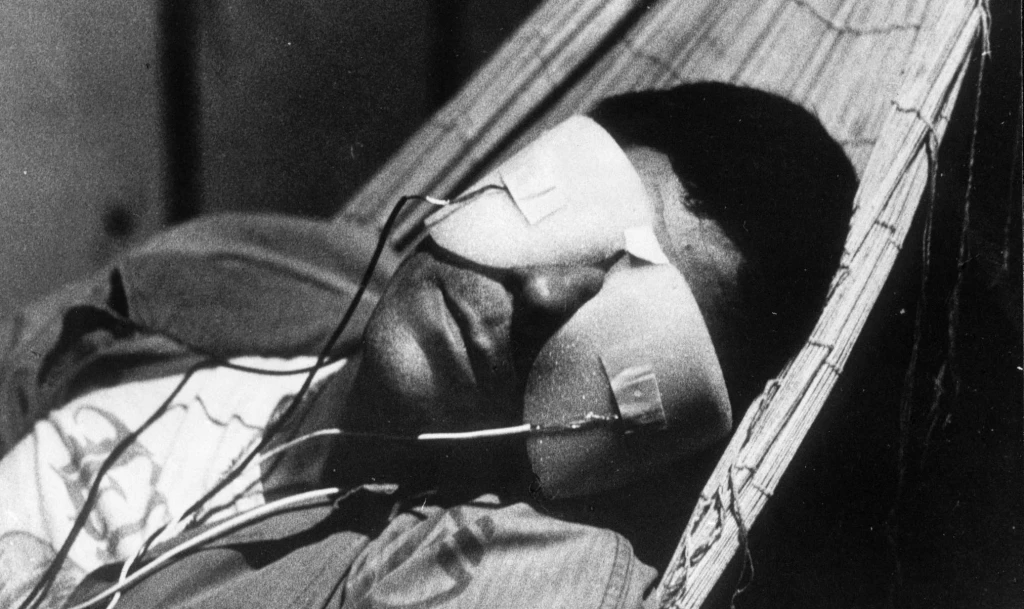
      Comparing La Jetee (The Short Movie) & 12 Monkeys (The Full-Length Movie)

      Overall the video was fascinating. La Jette offers an interesting type of film, similar to a modern music video that we did last year. It pieces clips of film together to tell a story. But there is no actual film; it's all photographs. On the other hand, 12 monkeys follow the traditional conventions of a movie with a heavy focus on voice-over narration. The two films share the same storyline and concept but are executed with very different visual aspects. 


      We appreciated the video's take that 12 monkeys was taken as a remodel, not a remake which can tend to come with a negative connotation. From the video, we were also intrigued by their focus on La Jette's editing style. For example, they used different techniques to convey the story, but how the 12 monkeys conveyed the same story differently. 


      Our biggest takeaway was how in the film La Jette the audio in a scene would be simple and undertoned yet helped to convey the emotions the director was attempting to showcase. Our other take away is how the movie also used cross fades and dissolves to create a dream-like aspect. We plan to use these techniques in our film to add depth to our short film, specifically the audio methods. We want to add simple sounds that convey emotion without being direct. 


      Overall this article was intriguing because it describes how the two different time periods and directing styles can convey the same storyline in opposite ways. For example, Chris Marker, director of La Jetee, was limited to the technology of his time, yet he chose to use black and white images, bringing them to life through the narrator and music. Yet, Terry Gilliam, director of 12 Monkeys, has access to many modern-day techniques and chooses to use upbeat music and many wide pans in his movie, conveying a large amount of motion on the complete other end from Marker's film.


      It'll help us in the filmmaking process. After researching the two styles, we can pull the directors techniques to help create the vision we wish to execute. We can use Marker's music technique and Gilliam's use of wide camera angles.


      Comparing 9 (The Short) & 9 (The Full-Length Movie)

      Short film:  The first thing we noticed was the quality of the film. It’s almost as if you’re filming with a camera whose lens is dirty. The poor quality, paired with the low lighting, was almost hard to watch. It was hard to see the characters at times, especially since they were carrying around a mere bulb they took from a lamp, and the sun was never out. The lighting goes with the genre, but it’s hard to understand what you can’t see. The film is also quite confusing on its own. The story follows a rag doll,9, at what appears to be the end of the world. A metal monster with one glowing green eye seems to want the souls of the rag dolls. During the short film, we don’t actually find out who the monster is and why it wants nine dead. Despite being made of cloth, the rag dolls seem to have a lot of emotion on their face. When five is killed, nine looks devastated and can be seen sulking, looking at the last thing he got from five not long after. Despite being a shorter film, it still has a good amount of media conventions. There were clips filmed at low angles to depict how tiny nine is compared to the world or how small he felt compared to the monster. There were panning shots to show him running away too. There was also a panning shot where the camera rose from a low angle to higher up the monster’s back, where it showed the cloth from five on him shortly after he defeated him and took his soul. Regarding the mis-en-scene, the characters didn’t wear clothes as they were rag dolls, so the directors focused on the background instead. There were a lot of old broken items, like a huge doll whose face appeared cracked, and items discarded in random areas, like the umbrella opened upside down. Almost all buildings were destroyed, and the sky looked murky and foggy to enhance the apocalyptic aspect. The diegetic and non-diegetic sounds were ominous from the start, with the film opening with an eerie-sounding background track adding in diegetic sounds such as the hammer clicking or the monster walking louder than the music to create more or a freight aspect. Lastly, we had the transition animations. Other than the quality, this is how you could tell it was a short film. The transitions were poor, resembling that of a PowerPoint presentation. There were some good ones, however, such as the clip where nine was cleaning the gadget in the beginning, and it flashes as if the light next to him flashes and pans from the gadget to his eyes to an extreme close-up and switched to a flashback of the first time five gave him the gadget. Overall this short film was not the best. The quality and transitions were poor, and the audience was barely given any context as to what was happening, so it was confusing.


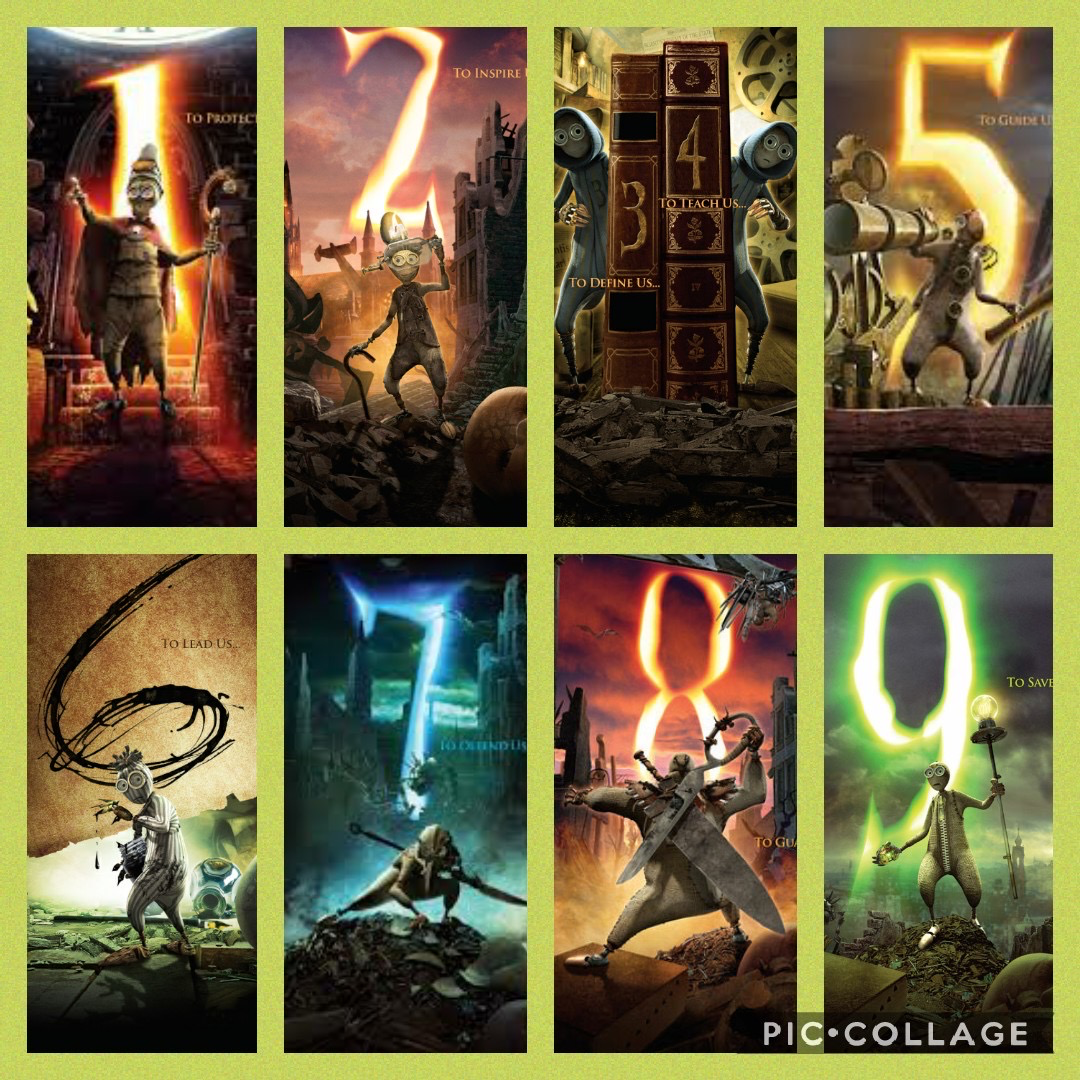
      Full-length film: We immediately noticed the huge improvement in camera quality compared to the short film. The characters are much better drawn, making them way more visible. There’s also a wider range of characters. In the short film, we only saw all the Stitchpunks at the very end, but in the full-length, we see them all pretty early on. We finally see the scientist who created them. The full-length film is more detailed, giving us the full history of the dolls. We see why nine was created, who and where the others were, what caused the mass robot takeover, and what the glowing mystery device was. We also see the conflict between the Stitchpunks and the robots and between the Stitchpunks and each other. This developed the backstory of why five and nine were close while the others were absent from the plot. The full-length movie had relatively the same camera angles as the short film. It did, however, have more overall conventions. Regarding mis-en-scene, while not all the ragdolls were dressed, they had something significant to them. Number one wore a cape and a huge hat to assert dominance or dub himself the leader, with number eight being the personal guard. Number eight was bigger and had a huge sword. Number six had the paintbrush and psychic powers, which made him a little strange. Overall, the full-length film is much better. Due to the budget increase, new equipment, and new directors, the potential of the film increased, making it better than the short film. 


      Comparison: The quality of the full-length film is much better than the short film. We could see the characters clearly, and the background didn’t look blurry. The full-length film was also much more detailed. The short film only gave us a piece of the plot, whereas the full-length film gave us the full history of the dolls, including how they came to be, why the world looks the way it does, and what the little trinket they carried was and why they were fighting metal creatures. The short film started towards the end of the conflict, almost as if it only showed the movie’s last few minutes. Since it didn’t introduce the conflict at all, it was more intriguing as it kept the viewers wondering what was happening. The problem with this is that the storyline was hard to follow because the viewers had no idea why nine was in what looked like a junkyard and why he was being targeted by a soul-sucking robot creature. Overall, the full-length movie was better because it’s more detailed, better quality, looked more professional, and has a wider range of camera angles, locations, characters, and other media conventions. There was a bigger budget for the full-length film, so they had more filming and editing equipment, which is why they could do higher or lower angles and make the transitions smoother. 


      Critical Reflection

      The products made represent the social issue of teenage friendship. The film shows the development of two teenage girls who go on to become ...